SGS VAD ALGORITHM USER GUIDE
REVISION HISTORY
| Revision No. | Description |
Date |
|---|---|---|
| 1.0 | 03/27/2024 | |
| 1.01 | 12/09/2024 | |
| 1.02 | 04/25/2025 | |
| 1.03 | 05/08/2025 | |
| 1.04 | 05/14/2025 | |
| 1.05 | 10/28/2025 | |
| 1.1 | 11/25/2025 | |
| 1.2 | 12/03/2025 |
1. Overview
1.1. Module Description
The Voice Activity Detection (VAD) algorithm is used to detect whether there is voice activity in the current input by processing the input sound.
1.2. Basic Structure

After the VAD algorithm allocates memory and completes parameter initialization and configuration, it only requires an input signal buffer. The VAD processes this input buffer according to the configured parameters and algorithm, then writes the detection results to the VAD output result pointer.
1.3. Function Introduction
VAD :
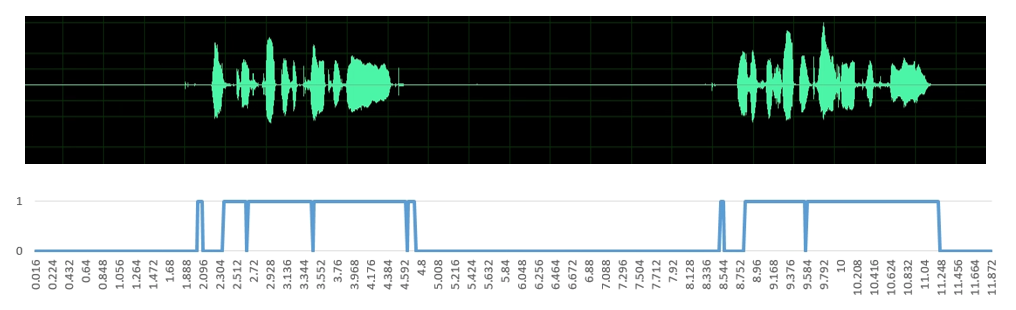
Detect intervals within the audio signal that contain speech activity.
1.4. Application Scenarios
In communication systems, it can determine whether the user is speaking and reduce bandwidth usage during silent periods for low-power applications. It can also reduce computational load by identifying speech segments, allowing the system to process only the portions that actually contain speech.
1.5. Chip Difference Description
Across different chip series, the VAD algorithm demonstrates consistent performance with no observable differences.
1.6. Example Introduction
Use the VAD API to obtain the memory size required by the VAD algorithm, initialize the VAD algorithm handle, configure parameters to the VAD handle, configure running mode to the VAD handle, execute the VAD algorithm, and release the VAD algorithm resources.

    #include <stdio.h>
    #include <string.h>
    #include <time.h>
    #include <stdlib.h>
    #ifndef OS_WINDOWS
    #include <sys/ioctl.h>
    #endif
    #include <sys/types.h>
    #include <sys/stat.h>
    #include <sys/time.h>

    #include "AudioVadProcess.h"


    #define USE_MALLOC   (1)
    unsigned int WorkingBuffer2[1] = {0};

    typedef unsigned char               uint8;
    typedef unsigned short              uint16;
    typedef unsigned long               uint32;

    float AVERAGE_RUN(int a)
    {
        static unsigned int num = 0;
        static float avg = 0;
        if(num == 0) avg = 0;
        num++;
        avg = avg + ((float)a - avg) / ((float)num);
        return avg;
    }
    unsigned int _OsCounterGetMs(void)
    {
        struct  timeval t1;
        gettimeofday(&t1,NULL);
        unsigned int T = ( (1000000 * t1.tv_sec)+ t1.tv_usec );
        return T;
    }


    int main(int argc, char *argv[])
    {
        short input[1024];
        char input_file[512];
        unsigned int T0, T1;
        float avg = 0;
        int counter=0;
        int mode = 1;
        int vad_result=0;
    #if USE_MALLOC
        char *working_buf_ptr = (char*)malloc(IaaVad_GetBufferSize());
    #else
        char working_buf_ptr[512*100*2];
    #endif

        FILE * fin;
        int ret1;

        VAD_HANDLE handle;
        VadInit vad_init;
        VadConfig vad_config;

        int PN=128;

        vad_init.point_number = PN;
        vad_init.channel = 1;
        vad_init.sample_rate = IAA_VAD_SAMPLE_RATE_8000;

        vad_config.vote_frame = 100;
        vad_config.sensitivity = VAD_SEN_HIGH;
        handle = IaaVad_Init((char *)working_buf_ptr, &vad_init);
        if(handle==NULL)
        {
            printf("VAD init error\r\n");
            return -1;
        }
        else
        {
            printf("VAD init succeed\r\n");
        }

        if(IaaVad_Config(handle, &vad_config))
        {
            printf("Config Error!");
            return -1;
        }
        if(IaaVad_SetMode(handle, mode))
        {
            printf("Config Error!");
            return -1;
        }
        if(argc < 2)
            sprintf(input_file,"%s","./../sample/data/merge_test3.wav");
        else
            strcpy(input_file, argv[1]);

        fin = fopen(input_file, "rb");
        if(!fin)
        {
            printf("the input file %s could not be open\n",input_file);
            return -1;
        }
        fread(input, sizeof(char), 44, fin); // read header 44 bytes
        while(fread(input, sizeof(short), vad_init.point_number*vad_init.channel, fin))
        {

            counter++;
            T0  = (long)_OsCounterGetMs();
            ret1 = IaaVad_Run(handle, input);
            IaaVad_GetResult(handle, &vad_result);
            T1  = (long)_OsCounterGetMs();
            avg += (T1 - T0);

            if(counter%1000== 999)
            {
                printf("counter = %d\n", counter);
                printf("current time = %f\t", (float)counter*PN/vad_init.sample_rate);
                printf("vad result = %d\t",vad_result);
                printf("process time = %lu(us)\n",(long)(T1 - T0));
            }

            if(ret1 < 0)
            {
                printf("Error occured in Voice Activity Detection\n");
                break;
            }

        }
        avg /= counter;
        printf("AVG is %.2f us\n",avg);
        IaaVad_Free(handle);
        free(working_buf_ptr);
        fclose(fin);

        printf("Done\n");
    return 0;
    }
Use the VAD API to read parameters from the VAD JSON file, obtain the memory size required for VAD algorithm execution, initialize the VAD algorithm handle, configure parameters to the handle, configure running mode to the handle, execute the VAD algorithm, and release the VAD algorithm resources.
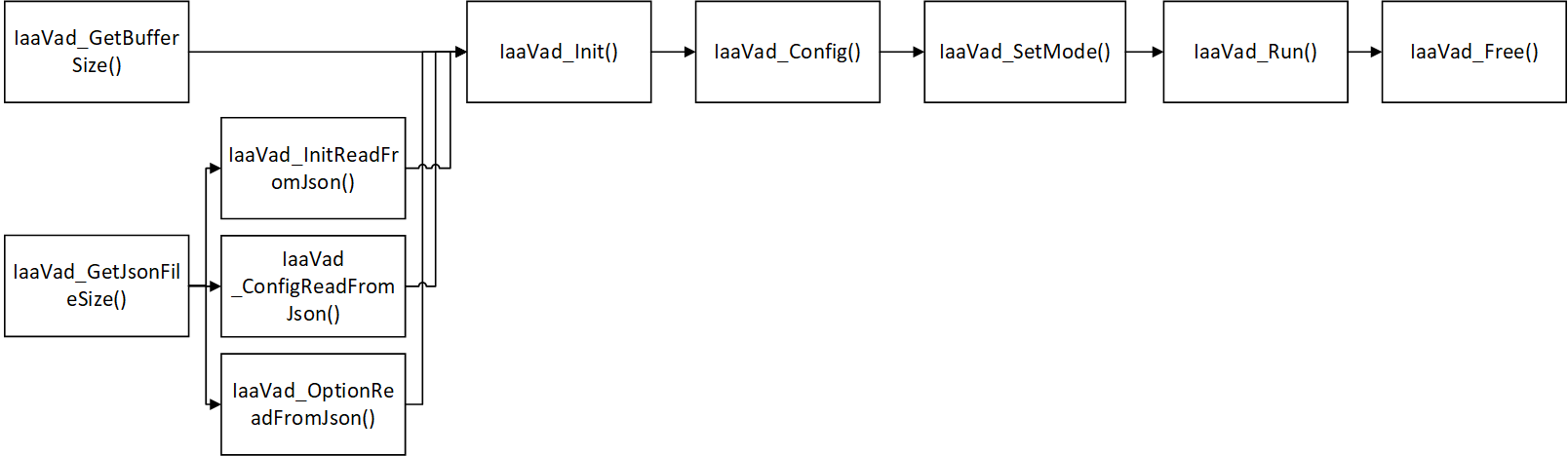
    #include <stdio.h>
    #include <string.h>
    #include <time.h>
    #include <stdlib.h>
    #ifndef OS_WINDOWS
    #include <sys/ioctl.h>
    #endif
    #include <sys/types.h>
    #include <sys/stat.h>
    #include <sys/time.h>

    #include "AudioVadProcess.h"


    #define USE_MALLOC   (1)
    unsigned int WorkingBuffer2[1] = {0};

    typedef unsigned char               uint8;
    typedef unsigned short              uint16;
    typedef unsigned long               uint32;

    float AVERAGE_RUN(int a)
    {
        static unsigned int num = 0;
        static float avg = 0;
        if(num == 0) avg = 0;
        num++;
        avg = avg + ((float)a - avg) / ((float)num);
        return avg;
    }
    unsigned int _OsCounterGetMs(void)
    {
        struct  timeval t1;
        gettimeofday(&t1,NULL);
        unsigned int T = ( (1000000 * t1.tv_sec)+ t1.tv_usec );
        return T;
    }


    int main(int argc, char *argv[])
    {
        short input[1024];
        char input_file[512];
        char output_file[512];
        unsigned int T0, T1;
        float avg = 0;
        int counter=0;
        FILE *fin, *fout;
        int ret1;
        int vad_result;

        VAD_HANDLE handle;
        VadInit vad_init;
        VadConfig vad_config;
        VadOption vad_option;
        char vad_para_json_file[512];
        sprintf(vad_para_json_file,"%s","./../sample/data/VadParamJson.json");
        unsigned int vad_para_buffersize = IaaVad_GetJsonFileSize(vad_para_json_file);

    #if USE_MALLOC
        char *working_buf_ptr = (char*)malloc(IaaVad_GetBufferSize());
        char *vad_para_json_buf_ptr = (char*)malloc(vad_para_buffersize);
    #else
        char working_buf_ptr[512*100*2];
        char vad_para_json_buf_ptr[512*100*2];
    #endif

        memset(&vad_init,0,sizeof(VadInit));
        memset(&vad_config,0,sizeof(VadConfig));
        memset(&vad_option,0,sizeof(VadOption));
        ret1 = IaaVad_InitReadFromJson(&vad_init, vad_para_json_buf_ptr, vad_para_json_file, vad_para_buffersize);
        ret1 = IaaVad_ConfigReadFromJson(&vad_config, vad_para_json_buf_ptr, vad_para_json_file, vad_para_buffersize);
        ret1 = IaaVad_OptionReadFromJson(&vad_option, vad_para_json_buf_ptr, vad_para_json_file, vad_para_buffersize);


        handle = IaaVad_Init((char *)working_buf_ptr, &vad_init);
        if(handle==NULL)
        {
            printf("VAD init error\r\n");
            return -1;
        }
        else
        {
            printf("VAD init succeed\r\n");
        }

        if(IaaVad_Config(handle, &vad_config))
        {
            printf("Config Error!");
            return -1;
        }
        if(IaaVad_SetMode(handle, vad_option.mode))
        {
            printf("Config Error!");
            return -1;
        }
        if(argc < 2)
            sprintf(input_file,"%s","./../sample/data/merge_test3.wav");
        else
            strcpy(input_file, argv[1]);

        sprintf(output_file,"%s","./../sample/data/VAD_result.txt");

        fin = fopen(input_file, "rb");
        if(!fin)
        {
            printf("the input file %s could not be open\n",input_file);
            return -1;
        }

        fout = fopen(output_file, "w");
            if(!fin)
        {
            printf("the output file %s could not be open\n",output_file);
            return -1;
        }

        fread(input, sizeof(char), 44, fin); // read header 44 bytes
        fprintf(fout,"%s\t%s\n","time","vad result");
        while(fread(input, sizeof(short), vad_init.point_number*vad_init.channel, fin))
        {

        counter++;
        T0  = (long)_OsCounterGetMs();
        ret1 = IaaVad_Run(handle, input);
        IaaVad_GetResult(handle, &vad_result);
        T1  = (long)_OsCounterGetMs();
        avg += (T1 - T0);

        if(counter%1000== 999)
        {
            printf("counter = %d\n", counter);
            printf("current time = %f\t", (float)counter*vad_init.point_number/vad_init.sample_rate);
            printf("vad result = %d\t",vad_result);
            printf("process time = %lu(us)\n",(long)(T1 - T0));
        }

        fprintf(fout,"%f\t%d\n",(float)counter*vad_init.point_number/vad_init.sample_rate,vad_result);

        if(ret1 < 0)
        {
            printf("Error occured in Voice Activity Detection\n");
            break;
        }

        }
        avg /= counter;
        printf("AVG is %.2f us\n",avg);
        IaaVad_Free(handle);
        free(working_buf_ptr);
        fclose(fin);
        fclose(fout);
        printf("Done\n");
    return 0;
    }
2. API Reference
| API Name | Function |
|---|---|
| IaaVad_GetBufferSize | Get the memory size required to run the VAD algorithm |
| IaaVad_Init | Initialize VAD algorithm |
| IaaVad_Config | Set VAD algorithm parameters |
| IaaVad_Run | Run VAD algorithm |
| IaaVad_Free | Free VAD algorithm resources |
| IaaVad_SetMode | Set VAD operation mode |
| IaaVad_GetJsonFileSize | VAD get size of json file |
| IaaVad_InitReadFromJson | Set json parameter into VAD init structure |
| IaaVad_ConfigReadFromJson | Set json parameter into VAD config structure |
| IaaVad_OptionReadFromJson | Set json parameter into VAD option structure |
| IaaVad_GetResult | Get VAD algorithm result |
2.1. IaaVad_GetBufferSize
-
Function
Get the memory size required to run the VAD algorithm.
-
Syntax
unsigned int IaaVad_GetBufferSize(void); -
Parameter
Parameter Name Description Input/Output N/A -
Return Value
The return value is the memory size required to run the VAD algorithm.
-
Dependency
-
Header file: AudioVadProcess.h
-
Library file: libVAD_LINUX.so/ libVAD_LINUX.a
-
-
Note
This interface only returns the required memory size, and the application and release of memory needed to be handled by the application.
-
Example
Please refer to the Example Introduction
2.2. IaaVad_Init
-
Function
Initialize the VAD algorithm.
-
Syntax
VAD_HANDLE IaaVad_Init(char* const working_buffer_address, VadInit *vad_init); -
Parameter
Parameter name Description Input/Output working_buffer_address Memory address used by VAD algorithm Input vad_init Initialization structure pointer of VAD algorithm Input -
Return value
Return value Result Not NULL Successful NULL Failed -
Dependency
-
Header file: AudioVadProcess.h
-
Library file: libVAD_LINUX.so/ libVAD_LINUX.a
-
-
Example
Please refer to the Example Introduction
2.3. IaaVad_Config
-
Function
Set VAD algorithm parameters.
-
Syntax
ALGO_VAD_RET IaaVad_Config(VAD_HANDLE handle, VadConfig *vad_config); -
Parameter
Parameter name Description Input/Output handle VAD algorithm handle Input vad_config VAD algorithm parameter setting structure Input -
Return Value
Return value Result 0 Successful Non-zero Failed, refer to error code -
Dependency
-
Header file: AudioVadProcess.h
-
Library file: libVAD_LINUX.so/ libVAD_LINUX.a
-
-
Example
Please refer to the Example Introduction
2.4. IaaVad_Run
-
Function
Run VAD algorithm.
-
Syntax
ALGO_VAD_RET IaaVad_Run(VAD_HANDLE handle,short* pss_audio_in); -
Parameter
Parameter name Description Input/Output handle Algorithm handle Input pss_audio_in Input data pointer Input -
Return Value
Return value Result 0 Successful Non-zero Failed, refer to error code -
Dependency
-
Header file: AudioVadProcess.h
-
Library file: libVAD_LINUX.so/ libVAD_LINUX.a
-
-
Example
Please refer to the Example Introduction
2.5. IaaVad_Free
-
Function
Free the resources of the VAD algorithm.
-
Syntax
ALGO_VAD_RET IaaVad_Free(VAD_HANDLE handle); -
Parameter
Return value Result 0 Successful Non-zero Failed, refer to error code -
Return Value
Return value Result 0 Successful Non-zero Failed -
Dependency
-
Header file: AudioVadProcess.h
-
Library file: libVAD_LINUX.so/ libVAD_LINUX.a
-
-
Note
IaaVad_Free must be called first before releasing the memory used by the VAD algorithm.
-
Example
Please refer to the Example Introduction
2.6. IaaVad_SetMode
-
Function
Set VAD algorithm operation mode.
-
Syntax
ALGO_VAD_RET IaaVad_SetMode(VAD_HANDLE handle, int mode); -
Parameter
Parameter name Description Input/Output handle VAD algorithm handle Input mode Different VAD algorithms. 0~1 are different traditional human voice detection algorithms. 2~3 is the human voice detection method using deep learning Input -
Return Value
Return value Result 0 Successful Non-zero Failed, refer to error code -
Dependency
-
Header file: AudioVadProcess.h
-
Library file: libVAD_LINUX.so/ libVAD_LINUX.a
-
-
Example
Please refer to the Example Introduction
2.7. IaaVad_GetJsonFileSize
-
Features
VAD get size of json file.
-
Syntax
unsigned int IaaVad_GetJsonFileSize(char* jsonfile); -
Parameters
Parameter name Description Input/Output jsonfile name of json file Input -
Return value
Return value is the memory size required for decoding json file.
-
Dependency
-
Header: AudioVadProcess.h
-
Library: libVAD_LINUX.so/ libVAD_LINUX.a
-
2.8. IaaVad_InitReadFromJson
-
Features
Set json parameter into VAD init structure.
-
Syntax
ALGO_VAD_RET IaaVad_InitReadFromJson(VadInit* vad_init, char* jsonBuffer, char* jsonfile, unsigned int buffSize); -
Parameters
Parameter name Description Input/Output vad_init vad init structure Input jsonBuffer json buffer memory address Input jsonfile name of json file Input buffSize size of json file Input -
Return value
Return value Result 0 Successful Non-zero Failed, refer to error code -
Dependency
-
Header: AudioVadProcess.h
-
Library: libVAD_LINUX.so/ libVAD_LINUX.a
-
2.9. IaaVad_ConfigReadFromJson
-
Features
Set json parameter into VAD config structure.
-
Syntax
ALGO_VAD_RET IaaVad_ConfigReadFromJson(VadConfig* vad_config, char* jsonBuffer, char* jsonfile, unsigned int buffSize); -
Parameters
Parameter name Description Input/Output vad_config vad config structure Input jsonBuffer json buffer memory address Input jsonfile name of json file Input buffSize size of json file Input -
Return value
Return value Result 0 Successful Non-zero Failed, refer to error code -
Dependency
-
Header: AudioVadProcess.h
-
Library: libVAD_LINUX.so/ libVAD_LINUX.a
-
2.10. IaaVad_OptionReadFromJson
-
Features
Set json parameter into VAD option structure.
-
Syntax
ALGO_VAD_RET IaaVad_OptionReadFromJson(VadOption* vad_option, char* jsonBuffer, char* jsonfile, unsigned int buffSize); -
Parameters
Parameter name Description Input/Output vad_option vad option structure Input jsonBuffer json buffer memory address Input jsonfile name of json file Input buffSize size of json file Input -
Return value
Return value Result 0 Successful Non-zero Failed, refer to error code -
Dependency
-
Header: AudioVadProcess.h
-
Library: libVAD_LINUX.so/ libVAD_LINUX.a
-
2.11. IaaVad_GetResult
-
Function
Get VAD algorithm result.
-
Syntax
ALGO_VAD_RET IaaVad_GetResult(VAD_HANDLE handle, int* vad_result); -
Parameter
Parameter name Description Input/Output handle VAD algorithm handle Input vad_result vad result output. 0: Un-detect Speech. 1: Detect Speech. Output -
Return Value
Return value Result 0 Successful Non-zero Failed, refer to error code -
Dependency
-
Header file: AudioVadProcess.h
-
Library file: libVAD_LINUX.so/ libVAD_LINUX.a
-
-
Example
Please refer to the Example Introduction
3. VAD Data Type
The relevant data types of the VAD module are defined as follows:
| Data Type | Definition |
|---|---|
| IAA_VAD_SAMPLE_RATE | Sampling rate type of VAD algorithm |
| VadSensitivity | Sensitivity type of VAD algorithm |
| VadInit | Initialization data structure type of VAD algorithm |
| VadConfig | Parameter setting structure type of VAD algorithm |
| VAD_HANDLE | Handle type of VAD algorithm |
| VadOption | Option setting structure type of VAD algorithm |
3.1. IAA_VAD_SAMPLE_RATE
-
Description
Define the sampling rate type of the VAD algorithm.
-
Definition
typedef enum { IAA_VAD_SAMPLE_RATE_8000 = 8000, IAA_VAD_SAMPLE_RATE_16000 = 16000, IAA_VAD_SAMPLE_RATE_48000 = 48000, }IAA_VAD_SAMPLE_RATE; -
Member
Member name Description IAA_VAD_SAMPLE_RATE_8000 Sampling rate 8000Hz IAA_VAD_SAMPLE_RATE_16000 Sampling rate 16000Hz IAA_VAD_SAMPLE_RATE_48000 Sampling rate 48000Hz -
Note
MODE2 and MODE3 only support 8000 Hz sampling rate.
-
Related Data Type and Interface
3.2. VadSensitivity
-
Description
Define the sensitivity type of the VAD algorithm.
-
Definition
typedef enum { VAD_SEN_LOW, VAD_SEN_MID, VAD_SEN_HIGH, }VadSensitivity; -
Member
Member name Description VAD_SEN_LOW Low sensitivity, harder to detect human voice VAD_SEN_MID Medium sensitivity VAD_SEN_HIGH High sensitivity, easier to detect human voice -
Note
N/A.
-
Related Data Type and Interface
3.3. VadInit
-
Description
Define the initialization parameter type of the VAD algorithm.
-
Definition
typedef struct { unsigned int point_number; unsigned int channel; IAA_VAD_SAMPLE_RATE sample_rate; }VadInit; -
Member
Member name Description point_number The number of sampling points processed by the VAD algorithm once channel Channel number sample_rate Sampling rate, currently supports 8k/16k/48k -
Note
N/A.
-
Related Data Type and Interface
3.4. VadConfig
-
Description
Define the configuration parameter structure type of the VAD algorithm.
-
Definition
typedef struct { unsigned int vote_frame; VadSensitivity sensitivity; }VadConfig; -
Member
Member Name Description vote_frame In mode 0, the length required for the final estimated result, that is, the number of delayed frames. Other modes are not affected by this parameter. sensitivity Sensitivity setting -
Related Data Type and Interface
3.5. VAD_HANDLE
-
Description
Define the handle type of the VAD algorithm.
-
Definition
typedef void* VAD_HANDLE;
-
Member
Member name Description N/A -
Note
N/A.
-
Related Data Type and Interface
3.6. VadOption
-
Description
Define the option parameter structure type of the VAD algorithm.
-
Definition
typedef struct{ int mode; }VadOption; -
Member
Member name Description mode set mode in VAD algorithm, use in IaaVad_SetMode -
Note
N/A
-
Related Data Type and Interface
4. ERROR CODE
VAD API error codes are shown as follow:
| Error code | Definition | Description |
|---|---|---|
| 0x00000000 | ALGO_VAD_RET_SUCCESS | VAD runs successfully |
| 0x10000901 | ALGO_VAD_RET_INIT_ERROR | VAD isn't initialized |
| 0x10000902 | ALGO_VAD_RET_INVALID_HANDLE | VAD HANDLE is invalid |
| 0x10000903 | ALGO_VAD_RET_INVALID_SAMPLE_RATE | Sampling frequency doesn't support |
| 0x10000904 | ALGO_VAD_RET_INVALID_POINT_NUMBER | Points per frame doesn't support |
| 0x10000905 | ALGO_VAD_RET_INVALID_CHANNEL | Channel number doesn't support |
| 0x10000906 | ALGO_VAD_RET_INVALID_CONFIG | Incorrect config setting |
| 0x10000907 | ALGO_VAD_RET_INVALID_MODE | VAD mode parameter setting is invalid |
| 0x10000908 | ALGO_VAD_RET_API_CONFLICT | Other APIs are running |
| 0x10000909 | ALGO_VAD_RET_INVALID_CALLING | Incorrect order of calling API |
| 0x10000910 | ALGO_VAD_RET_INVALID_JSONFILE | VAD fails to read json file |