SGS AEC ALGORITHM USER GUIDE
REVISION HISTORY
| Revision No. | Description |
Date |
|---|---|---|
| 1.0 | 09/08/2020 | |
| 1.1 | 10/15/2020 | |
| 1.2 | 02/16/2022 | |
| 1.21 | 08/18/2022 | |
| 1.22 | 10/25/2022 | |
| 1.23 | 03/10/2023 | |
| 1.3 | 04/14/2023 | |
| 1.31 | 07/12/2023 | |
| 1.4 | 02/19/2024 | |
| 1.5 | 10/30/2024 | |
| 1.51 | 03/24/2025 | |
| 1.52 | 04/19/2025 | |
| 1.53 | 05/13/2025 | |
| 1.54 | 07/16/2025 | |
| 1.6 | 08/01/2025 | |
| 1.7 | 08/15/2025 | |
| 1.71 | 09/23/2025 | |
| 1.72 | 10/28/2025 | |
| 1.73 | 11/21/2025 |
1. OVERVIEW
1.1. Module Description
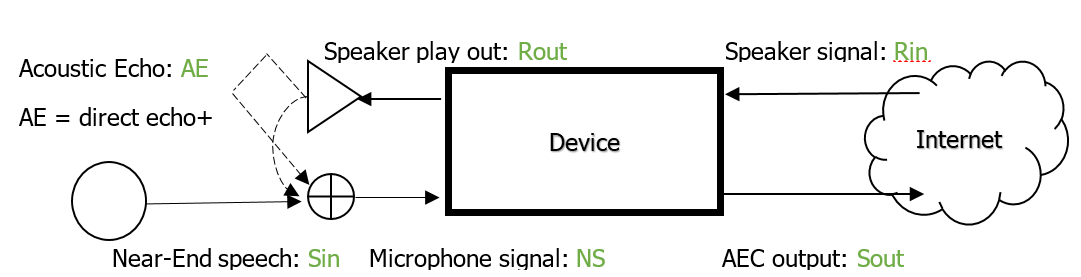
AEC (short for Acoustic Echo Cancellation) is a function used to suppress far-end echo.
Echo is common in conference systems, building intercom, security monitoring and other scenarios. When the far-end sound is played from the speaker, the microphone re-collects the sound played by the speaker and transmits it back to the far-end after a very small delay, which will cause an echo to be heard at the far-end.
Keyword
-
Far-end signal (Sin)
The signal source of the device speaker, or the signal from the remote.
-
Near-end signal (Rin)
The signal recorded by the microphone of the device, which may include acoustic echo and near-end talker signals.
-
Acoustic echo (AE)
The sound played from the speaker of the device is transmitted back to the microphone through a direct or indirect path, and the echo is generated. The far-end talker will hear his echo after a certain delay after speaking. This echo is claimed as an acoustic echo (AE).
-
Single talk
Only the speaker on the device side plays the far-end signal (Sin = AE + NS when NS =0)
-
Double talk
While the speaker on the device side is playing, the near-end talker also speaks into the microphone (Sin = AE + NS when NS≠0)
Note
In order to facilitate debugging and confirm the effect of the algorithm, the user application needs to implement replacement algorithm parameter and grab audio data.
1.2. Basic Structure
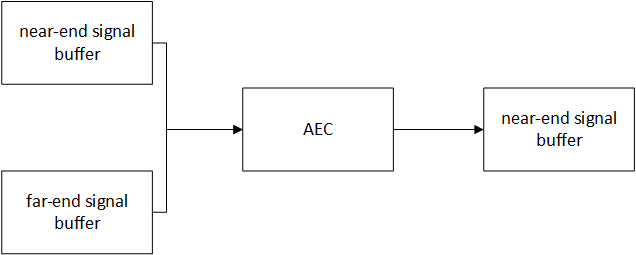
After the AEC algorithm allocates memory and completes parameter initialization and configuration, it requires an input Near-End signal buffer and an input Far-End signal buffer. The AEC processes the Near-End and Far-End buffers according to the configured parameters and algorithm, and then writes the processed data back to the Near-End input buffer.
1.3. Function Introduction
AEC :
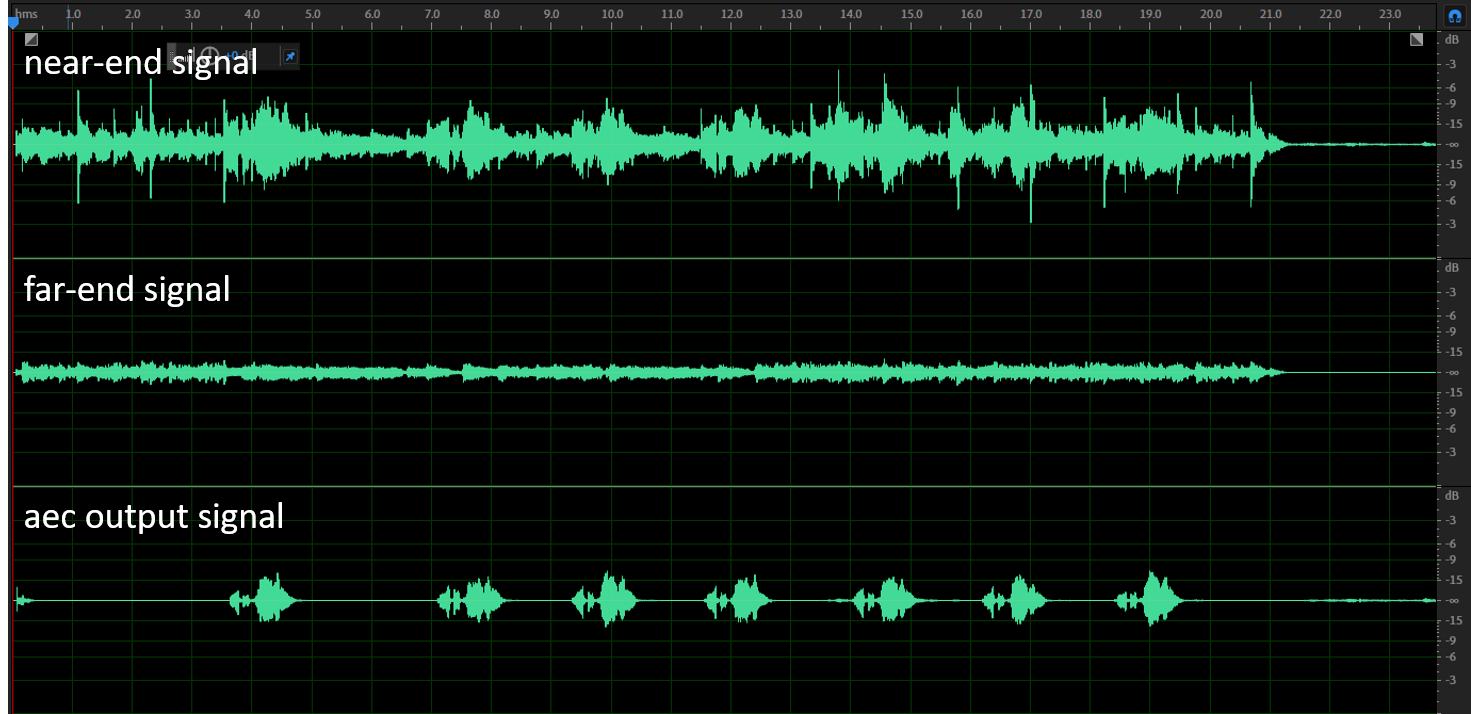
To remove the far-end signal present in the near-end audio, preventing the occurrence of acoustic echo.
1.4. Application Scenarios
AEC is commonly used in conference systems, building intercoms, and security monitoring, preventing the far-end system from capturing its own acoustic echo due to signal transmission delays.
1.5. Chip Difference Description
Across different chip series, the AEC algorithm demonstrates consistent performance with no observable differences.
1.6. Example Introduction
Use the AEC API to obtain the memory size required by the AEC algorithm, initialize the AEC algorithm handle, configure parameters to the AEC handle, execute the AEC algorithm, and release the AEC algorithm resources.

    #include <stdio.h>
    #include <unistd.h>
    #include <fcntl.h>
    #include <string.h>
    #include <time.h>
    #ifndef OS_WINDOWS
    #include <sys/ioctl.h>
    #endif
    #include <sys/types.h>
    #include <sys/stat.h>
    #include <stdlib.h>
    #include <string.h>
    #include <sys/time.h>

    #include "AudioAecProcess.h"

    #define USE_MALLOC      (1)
    typedef unsigned char   uint8;
    typedef unsigned short  uint16;
    typedef unsigned long   uint32;

    float AVERAGE_RUN(int a)
    {
        static unsigned int num = 0;
        static float avg = 0;

            if(num == 0)
                avg = 0;

            num++;
            avg = avg + ((float)a - avg) / ((float)num);


        return avg;
    }
    unsigned int _OsCounterGetMs(void)
    {
        struct  timeval t1;
        gettimeofday(&t1,NULL);
        unsigned int T = ( (1000000 * t1.tv_sec)+ t1.tv_usec ) / 1000;
        return T;
    }

    int main(int argc, char *argv[])
    {
        short input[1024];
        short input_aec[1024];
    #if USE_MALLOC
        char *WorkingBuffer2;
    #else
        char WorkingBuffer2 [1024*500];
    #endif

        char infileName[512];
        char infileName_aec[512];
        char outfileName[512];
        int counter=0;
        unsigned int T0, T1;
        float avg;
        FILE * fin, * fout, * fin_aec;
        ALGO_AEC_RET ret;
        AudioAecInit aec_init;
        AudioAecConfig aec_config;
        AEC_HANDLE handle;

        unsigned int supMode_band[6] = {20,40,60,80,100,120};
        unsigned int supMode[7] = {4,4,4,4,4,4,4};

        int PN = 128;
        unsigned int recursive_ratio = 1;
        unsigned int block_num = 8;
        unsigned int mode = 0;
        aec_init.point_number = PN;
        aec_init.nearend_channel = 1;
        aec_init.farend_channel = 1;
        aec_config.delay_sample = 0;
        aec_init.sample_rate = IAA_AEC_SAMPLE_RATE_16000;
        aec_config.comfort_noise_enable = IAA_AEC_FALSE;
        memcpy(&(aec_config.suppression_mode_freq[0]),supMode_band,sizeof(int)*6);
        memcpy(&(aec_config.suppression_mode_intensity[0]),supMode,sizeof(int)*7);

    #if USE_MALLOC
        WorkingBuffer2 = (char*)malloc(IaaAec_GetBufferSize());
    #endif
        handle = IaaAec_Init((char*)WorkingBuffer2, &aec_init);
        if (handle==NULL)
        {
            printf("AEC init error\r\n");
            return -1;
        }
        else
        {
            printf("AEC init succeed\r\n");
        }
        sprintf(infileName,"%s",".//..//sample//data//AEC_AFE_16K_mono.wav"); //near
        sprintf(infileName_aec,"%s",".//..//sample//data//I2S_16K_mono.wav"); //far
        sprintf(outfileName,"%s",".//AecOut.wav");

        ret = IaaAec_Config(handle ,&(aec_config));
        ret += IaaAec_SetRecursiveRatio(handle, recursive_ratio);
        ret += IaaAec_SetADFBlockNum(handle, block_num);
        ret += IaaAec_SetMode(handle, mode);
        if(ret != ALGO_AEC_RET_SUCCESS)
        {
            printf("Error occured in AEC config function \n");
            return -1;
        }

        fin = fopen(infileName, "rb");
        if(!fin)
        {   printf("the input file could not be open\n");
            return -1;
        }

        fout = fopen(outfileName, "wb");
        if(!fout)
        {
            printf("the output file could not be open\n");
            return -1;
        }

        fread(input, sizeof(char), 44, fin); // read header 44 bytes
        fwrite(input, sizeof(char),44, fout); // write 44 bytes output


        fin_aec = fopen(infileName_aec, "rb");
        if(!fin_aec)
        {
            printf("the input file could not be open\n");
            return -1;
        }
        fread(input_aec, sizeof(char), 44, fin_aec); // read header 44 bytes
    #if __BYTE_ORDER__ == __ORDER_BIG_ENDIAN__
        printf("The chip is big-endian!!!\n");
        int k=0;
        short right = 0x0000;
        short left = 0x0000;
    #endif

        while(fread(input, sizeof(short), PN*aec_init.nearend_channel, fin))
        {
            fread(input_aec, sizeof(short), PN*aec_init.farend_channel, fin_aec);
    #if __BYTE_ORDER__ == __ORDER_BIG_ENDIAN__


            for(k=0;k<PN*aec_init.nearend_channel;k++)
            {
                right = (input[k]>>8)&(0x00ff);
                left = (input[k]<<8)&(0xff00);
                input[k] = left|right;
                right = (input_aec[k]>>8)&(0x00ff);
                left = (input_aec[k]<<8)&(0xff00);
                input_aec[k] = left|right;
            }

    #endif
            counter++;

            T0  = (long)_OsCounterGetMs();
            ret = IaaAec_Run(handle, input , input_aec );
            T1  = (long)_OsCounterGetMs();
            avg = AVERAGE_RUN(T1 - T0);

            if(counter%100 == 0)
            {
                printf("counter = %d\n", counter);
                printf("current time = %f\n", (float)counter*PN/aec_init.sample_rate);

                printf("process time = %lu(ms)\t",(long)(T1 - T0));
                printf("AVG is %.2f ms\n",avg);
            }
            if(ret != ALGO_AEC_RET_SUCCESS)
            {
                printf("Error occured in AEC run function \n");
                break;
            }

    #if __BYTE_ORDER__ == __ORDER_BIG_ENDIAN__


            for(k=0;k<PN*aec_init.nearend_channel;k++)
            {
                right = (input[k]>>8)&(0x00ff);
                left = (input[k]<<8)&(0xff00);
                input[k] = left|right;
            }

    #endif
            fwrite(input, sizeof(short), PN*aec_init.nearend_channel, fout);

        }
        ret = IaaAec_Free(handle);
        if(ret != ALGO_AEC_RET_SUCCESS)
        {
            printf("Error occured in AEC free function \n");
            return -1;
        }
        fclose(fin);
        fclose(fin_aec);
        fclose(fout);

        printf("Done\n");
    return 0;
    }
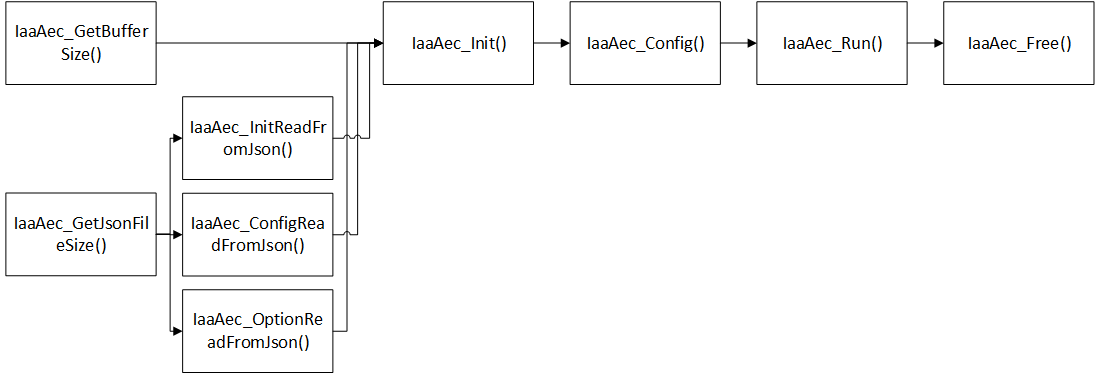
Use the AEC API to read parameters from the AEC JSON file, obtain the memory size required for AEC algorithm execution, initialize the AEC algorithm handle, configure parameters to the handle, execute the AEC algorithm, and release the AEC algorithm resources.
    #include <stdio.h>
    #include <unistd.h>
    #include <fcntl.h>
    #include <string.h>
    #include <time.h>
    #ifndef OS_WINDOWS
    #include <sys/ioctl.h>
    #endif
    #include <sys/types.h>
    #include <sys/stat.h>
    #include <stdlib.h>
    #include <string.h>
    #include <sys/time.h>


    #include "AudioAecProcess.h"


    #define PN              (128)
    #define USE_MALLOC      (1)
    typedef unsigned char    uint8;
    typedef unsigned short   uint16;
    typedef unsigned long    uint32;


    float AVERAGE_RUN(int a)
    {
        static unsigned int num = 0;
        static float avg = 0;

            if(num == 0)
                avg = 0;

            num++;
            avg = avg + ((float)a - avg) / ((float)num);


        return avg;
    }
    unsigned int _OsCounterGetMs(void)
    {
        struct  timeval t1;
        gettimeofday(&t1,NULL);
        unsigned int T = ( (1000000 * t1.tv_sec)+ t1.tv_usec ) / 1000;
        return T;
    }

    int main(int argc, char *argv[])
    {
        short input[256];
        short input_aec[256];
    #if USE_MALLOC
        char *WorkingBuffer2;
    #else
        char WorkingBuffer2 [1024*500];
    #endif

        char infileName[512];
        char infileName_aec[512];
        char outfileName[512];
        int counter=0;
        unsigned int T0, T1;
        float avg;
        FILE * fin, * fout, * fin_aec;


        char aec_para_json_file[512];
        sprintf(aec_para_json_file,"%s","./../sample/data/AecParamJson.json");
        unsigned int aec_para_buffersize = IaaAec_GetJsonFileSize(aec_para_json_file);


    #if USE_MALLOC
        WorkingBuffer2 = (char*)malloc(IaaAec_GetBufferSize());
        char *aec_para_json_buf_ptr = (char*)malloc(aec_para_buffersize);
    #endif

        ALGO_AEC_RET ret;
        AudioAecInit aec_init;
        AudioAecConfig aec_config;
        AEC_HANDLE handle;
        AudioAecOption aec_option;

        memset(&aec_init,0,sizeof(AudioAecInit));
        memset(&aec_config,0,sizeof(AudioAecConfig));
        memset(&aec_option,0,sizeof(AudioAecOption));
        ret = IaaAec_InitReadFromJson(&aec_init, aec_para_json_buf_ptr, aec_para_json_file, aec_para_buffersize);
        ret += IaaAec_ConfigReadFromJson(&aec_config, aec_para_json_buf_ptr, aec_para_json_file, aec_para_buffersize);
        ret += IaaAec_OptionReadFromJson(&aec_option, aec_para_json_buf_ptr, aec_para_json_file, aec_para_buffersize);


        handle = IaaAec_Init((char*)WorkingBuffer2, &aec_init);
        if (handle==NULL)
        {
            printf("AEC init error\r\n");
            return -1;
        }
        else
        {
            printf("AEC init succeed\r\n");
        }
        sprintf(infileName,"%s","./../sample/data/AEC_AFE_16K_mono.wav"); //near
        sprintf(infileName_aec,"%s","./../sample/data/I2S_16K_mono.wav"); //far
        sprintf(outfileName,"%s","./../sample/data/AecOut.wav");

        ret += IaaAec_Config(handle ,&(aec_config));
        ret += IaaAec_SetRecursiveRatio(handle, aec_option.recursive_ratio);
        ret += IaaAec_SetADFBlockNum(handle, aec_option.block_num);
        ret += IaaAec_SetMode(handle, aec_option.mode);
        if(ret != ALGO_AEC_RET_SUCCESS)
        {
            printf("Error occured in AEC config function \n");
            return -1;
        }

        fin = fopen(infileName, "rb");
        if(!fin)
        {   printf("the input file could not be open\n");
            return -1;
        }

        fout = fopen(outfileName, "wb");
        if(!fout)
        {
            printf("the output file could not be open\n");
            return -1;
        }

        fread(input, sizeof(char), 44, fin); // read header 44 bytes
        fwrite(input, sizeof(char),44, fout); // write 44 bytes output


        fin_aec = fopen(infileName_aec, "rb");
        if(!fin_aec)
        {
            printf("the input file could not be open\n");
            return -1;
        }
        fread(input_aec, sizeof(char), 44, fin_aec); // read header 44 bytes
    #if __BYTE_ORDER__ == __ORDER_BIG_ENDIAN__
        printf("The chip is big-endian!!!\n");
        int k=0;
        short right = 0x0000;
        short left = 0x0000;
    #endif

        while(fread(input, sizeof(short), PN*aec_init.nearend_channel, fin))
        {
            fread(input_aec, sizeof(short), PN*aec_init.farend_channel, fin_aec);
    #if __BYTE_ORDER__ == __ORDER_BIG_ENDIAN__


            for(k=0;k<PN*aec_init.nearend_channel;k++)
            {
                right = (input[k]>>8)&(0x00ff);
                left = (input[k]<<8)&(0xff00);
                input[k] = left|right;
                right = (input_aec[k]>>8)&(0x00ff);
                left = (input_aec[k]<<8)&(0xff00);
                input_aec[k] = left|right;
            }

    #endif
            counter++;

            T0  = (long)_OsCounterGetMs();
            ret = IaaAec_Run(handle, input , input_aec );
            T1  = (long)_OsCounterGetMs();
            avg = AVERAGE_RUN(T1 - T0);

            if(counter%100 == 0)
            {
                printf("counter = %d\n", counter);
                printf("current time = %f\n", (float)counter*PN/aec_init.sample_rate);

                printf("process time = %lu(ms)\t",(long)(T1 - T0));
                printf("AVG is %.2f ms\n",avg);
            }
            if(ret != ALGO_AEC_RET_SUCCESS)
            {
                printf("Error occured in AEC run function \n");
                break;
            }

    #if __BYTE_ORDER__ == __ORDER_BIG_ENDIAN__


            for(k=0;k<PN*aec_init.nearend_channel;k++)
            {
                right = (input[k]>>8)&(0x00ff);
                left = (input[k]<<8)&(0xff00);
                input[k] = left|right;
            }

    #endif
            fwrite(input, sizeof(short), PN*aec_init.nearend_channel, fout);

        }
        ret = IaaAec_Free(handle);
        if(ret != ALGO_AEC_RET_SUCCESS)
        {
            printf("Error occured in AEC free function \n");
            return -1;
        }
        fclose(fin);
        fclose(fin_aec);
        fclose(fout);

        printf("Done\n");
    return 0;
    }
2. API REFERENCE
2.1. API List
| API name | Features |
|---|---|
| IaaAec_GetBufferSize | Get the memory size required for Aec algorithm running |
| IaaAec_Init | Initialize the memory required for the Aec algorithm |
| IaaAec_Config | Configure Aec algorithm |
| IaaAec_Reset | Reinitialize the memory of Aec algorithm |
| IaaAec_Free | Release Aec algorithm resources |
| IaaAec_Run | Aec algorithm processing |
| IaaAec_GetLibVersion | Get the version information of the Aec algorithm |
| IaaAec_SetRecursiveRatio | Set Aec recursive ratio for adjusting converge speed. |
| IaaAec_ADF_Run | Run Linear Aec algorithm. |
| IaaAec_NLP_Run | Run Non-Linear Aec algorithm. |
| IaaAec_GetConfig | Get the Aec algorithm current configuration parameters. |
| IaaAec_GetAPIVersion | Get API version. |
| IaaAec_SetHandleId | Set Aec Handle Id |
| IaaAec_GetJsonFileSize | Get the memory size to parse the content of the Json file required by Aec algorithm |
| IaaAec_InitReadFromJson | Configure Json parameters to the init structure of the Aec algorithm |
| IaaAec_ConfigReadFromJson | Configure Json parameters to the config structure of the Aec algorithm |
| IaaAec_OptionReadFromJson | Configure Json parameters to the option structure of the Aec algorithm |
| IaaAec_SetADFBlockNum | Set Aec adf block number at different sampling rate |
| IaaAec_SetMode | Set Aec mode |
2.2. IaaAec_GetBufferSize
-
Features
Get the memory size required for Aec algorithm running.
-
Syntax
unsigned int IaaAec_GetBufferSize(void); -
Parameters
Parameter name Description Input/Output -
Return value
Return value is the memory size required for Aec algorithm running.
-
Dependency
-
Header: AudioAecProcess.h
-
Library: libAEC_LINUX.so/ libAEC_LINUX.a
-
-
Note
The interface only returns the required memory size, and the application and release of memory need to be processed by the application.
-
Example
None.
2.3. IaaAec_Init
-
Features
Initialize the memory required for the Aec algorithm.
-
Syntax
AEC_HANDLE IaaAec_Init (char* working_buffer_address, AudioAecInit * aec_init); -
Parameters
Parameter Name Description Input/Output working_buffer_address Memory address used by Aec algorithm input aec_init Aec algorithm initialization structure pointer input -
Return value
Return value Result 0 Successful Non-zero Failed, refer to error code -
Dependency
-
Header: AudioAecProcess.h
-
Library: libAEC_LINUX.so / libAEC_LINUX.a
-
-
Note
- Aec algorithm only supports 8K/16K sampling rate.
-
Example
None.
2.4. IaaAec_Config
-
Features
Configure Aec algorithm.
-
Syntax
ALGO_AEC_RET IaaAec_Config(AEC_HANDLE handle, AudioAecConfig *aec_config); -
Parameters
Parameter Name Description Input/Output handle Aec algorithm handle input aec_config Aec algorithm configuration parameter structure pointer input -
Return value
Return value Result 0 Successful Non-zero Failed, refer to error code -
Dependency
-
Header: AudioAecProcess.h
-
Library: libAEC_LINUX.so / libAEC_LINUX.a
-
-
Example
None.
2.5. IaaAec_Reset
-
Features
Reinitialize the memory of Aec algorithm.
-
Syntax
AEC_HANDLE IaaAec_Reset(char* working_buffer_address, AudioAecInit * aec_init); -
Parameters
Parameter Name Description Input/Output working_buffer_address Memory address used by Aec algorithm input aec_init Aec algorithm initialization structure pointer input -
Return value
Return value Result 0 Successful Non-zero Failed, refer to error code -
Dependency
-
Header: AudioAecProcess.h
-
Library: libAEC_LINUX.so/ libAEC_LINUX.a
-
-
Note
-
Reinitialize the Aec algorithm for the same algorithm handle (same memory address) (that is, reset the sampling rate and the number of near-end and far-end channels)
-
After re-initializing the Aec algorithm, it needs to be reconfigured
-
-
Example
None.
2.6. IaaAec_Free
-
Features
Release Aec algorithm resources
-
Syntax
ALGO_AEC_RET IaaAec_Free(AEC_HANDLE handle); -
Parameters
Parameter Name Description Input/Output handle Aec algorithm handle input -
Return value
Return value Result 0 Successful Non-zero Failed, refer to error code -
Dependency
-
Header: AudioAecProcess.h
-
Library: libAEC_LINUX.so/ libAEC_LINUX.a
-
-
Note
- Must call IaaAec_Free first, and then release the memory used by the Aec algorithm.
-
Example
None.
2.7. IaaAec_Run
-
Features
Aec algorithm processing
-
Syntax
ALGO_AEC_RET IaaAec_Run(AEC_HANDLE handle, short* pss_audio_near_end, short* pss_audio_far_end); -
Parameters
Parameter Name Description Input/Output handle Algorithm handle input pss_audio_near_end Near-end data pointer input/output pss_audio_far_end Far-end data pointer input -
Return value
Return value Result 0 Successful Non-zero Failed, refer to error code -
Dependency
-
Header: AudioAecProcess.h
-
Library: libAEC_LINUX.so/ libAEC_LINUX.a
-
-
Note
-
The amount of near-end and far-end data must correspond to the point_number (the number of sampling points required for one IaaAec_Run) when calling IaaAec_Init.
-
The result after AEC is output by pss_audio_near_end.
-
If the input data is stereo, please arrange the left and right channel by turns.
-
-
Example
- Please refer to the Example Introduction
2.8. IaaAec_GetLibVersion
-
Features
Get the version information of the Aec algorithm.
-
Syntax
ALGO_AEC_RET IaaAec_GetLibVersion(unsigned short *ver_year, unsigned short *ver_date, unsigned short *ver_time); -
Parameters
Parameter Name Description Input/Output ver_year Year when Aec Algorithm Library was built output ver_date Date when Aec Algorithm Library was built output ver_time Date when Aec Algorithm Library was built output -
Return value
Return value Result 0 Successful Non-zero Failed, refer to error code -
Dependency
-
Header: AudioAecProcess.h
-
Library: libAEC_LINUX.so/ libAEC_LINUX.a
-
-
Note
None.
-
Example
None.
2.9. IaaAec_SetRecursiveRatio
-
Features
Set Aec recursive ratio for adjusting converge speed.
-
Syntax
ALGO_AEC_RET IaaAec_SetRecursiveRatio(AEC_HANDLE handle, unsigned int recursive_ratio); -
Parameters
Parameter Name Description Input/Output handle Aec algorithm handle input recursive_ratio Recursive parameter input. Larger the value, Faster the converge speed. For the scenario of switching from double talk to single talk, decrease AEC over suppress near end signal. BUT echo suppress would be more aggressive. The discontinuity of background noise become worse.
Range: 1~10.input -
Return value
Return value Result 0 Successful Non-zero Failed, refer to error code -
Dependency
-
Header: AudioAecProcess.h
-
Library: libAEC_LINUX.so/ libAEC_LINUX.a
-
-
Example
None.
2.10. IaaAec_ADF_Run
-
Features
Aec linear algorithm processing
-
Syntax
ALGO_AEC_RET IaaAec_ADF_Run(AEC_HANDLE handle, short* pss_audio_near_end, short* pss_audio_far_end); -
Parameters
Parameter Name Description Input/Output handle Algorithm handle input pss_audio_near_end Near-end data pointer input/output pss_audio_far_end Far-end data pointer input -
Return value
Return value Result 0 Successful Non-zero Failed, refer to error code -
Dependency
-
Header: AudioAecProcess.h
-
Library: libAEC_LINUX.so/ libAEC_LINUX.a
-
-
Note
-
The amount of near-end and far-end data must correspond to thepoint_number (the number of sampling points required for one IaaAec_ADF_Run) when calling IaaAec_Init.
-
The result after linear AEC is output by pss_audio_near_end.
-
If the input data is stereo, please arrange the left and right channel by turns.
-
-
Example
None.
2.11. IaaAec_NLP_Run
-
Features
Aec non-linear algorithm processing
-
Syntax
ALGO_AEC_RET IaaAec_NLP_Run(AEC_HANDLE handle, short* pss_audio_near_end); -
Parameters
Parameter Name Description Input/Output handle Algorithm handle input pss_audio_near_end Near-end data pointer input/output -
Return value
Return value Result 0 Successful Non-zero Failed, refer to error code -
Dependency
-
Header: AudioAecProcess.h
-
Library: libAEC_LINUX.so/ libAEC_LINUX.a
-
-
Note
-
The amount of near-end data must correspond to the point_number (the number of sampling points required for one IaaAec_NLP_Run) when calling IaaAec_Init.
-
The result after non-linear AEC is output by pss_audio_near_end.
-
If the input data is stereo, please arrange the left and right channel by turns.
-
-
Example
None.
2.12. IaaAec_GetConfig
-
Features
Get the Aec algorithm current configuration parameters.
-
Syntax
ALGO_AEC_RET IaaAec_GetConfig(AEC_HANDLE handle, AudioAecInit * aec_init, AudioAecConfig *aec_config); -
Parameters
Parameter Name Description Input/Output handle Aec algorithm handle Input aec_init Aec algorithm initialization structure pointer Output aec_config The current Aec configuration parameters in the Aec algorithm Output -
Return value
Return value Result 0 Successful Non-zero Failed, refer to error code -
Dependency
-
Header: AudioAecProcess.h
-
Library: libAEC_LINUX.so/ libAEC_LINUX.a
-
-
Example
None.
2.13. IaaAec_GetAPIVersion
-
Features
Get Aec API version.
-
Syntax
ALGO_AEC_RET IaaAec_GetAPIVersion(unsigned short* major, unsigned short* minor); -
Parameters
Parameter Name Description Input/Output major Return version output minor Return version output -
Return value
Return value Result 0 Successful Non-zero Failed, refer to error code -
Dependency
-
Header: AudioAecProcess.h
-
Library: libAEC_LINUX.so/ libAEC_LINUX.a
-
-
Example
None.
2.14. IaaAec_SetHandleId
-
Features
Set Aec Handle Id.
-
Syntax
ALGO_AEC_RET IaaAec_SetHandleId(AEC_HANDLE handle, int id); -
Parameters
Parameter name Description Input/Output handle Aec algorithm handle Input id Aec handle id
range:[0,100]Input -
Return value
Return value Result 0 Successful Non-zero Failed, refer to error code -
Dependency
-
Header: AudioAecProcess.h
-
Library: libAEC_LINUX.so/ libAEC_LINUX.a
-
-
Example
None.
2.15. IaaAec_GetJsonFileSize
-
Features
Get the memory size to parse the content of the Json file required by Aec algorithm
-
Syntax
unsigned int IaaAec_GetJsonFileSize(char* jsonfile); -
Parameters
Parameter name Description Input/Output jsonfile Json file name Input -
Return value
The return value is the memory size required to parse the Json file content.
-
Dependency
-
Header: AudioAecProcess.h
-
Library: libAEC_LINUX.so/ libAEC_LINUX.a
-
-
Example
None.
2.16. IaaAec_InitReadFromJson
-
Features
Configure Json parameters to the init structure of the Aec algorithm
-
Syntax
ALGO_AEC_RET IaaAec_InitReadFromJson(AudioAecInit *aec_init, char* jsonBuffer, char* jsonfile, unsigned int buffSize); -
Parameters
Parameter name Description Input/Output aec_init Configure the init structure of the Aec algorithm Input/Output jsonBuffer The memory address used to parse the Json file content Input jsonfile Json file name Input buffSize The memory size required to parse the Json file content Input -
Return value
Return value Result 0 Successful Non-zero Failed, refer to error code -
Dependency
-
Header: AudioAecProcess.h
-
Library: libAEC_LINUX.so/ libAEC_LINUX.a
-
-
Example
None.
2.17. IaaAec_ConfigReadFromJson
-
Features
Configure Json parameters to the config structure of the Aec algorithm
-
Syntax
ALGO_AEC_RET IaaAec_ConfigReadFromJson(AudioAecConfig *aec_config, char* jsonBuffer, char* jsonfile, unsigned int buffSize); -
Parameters
Parameter name Description Input/Output aec_config Configure the config structure of the Aec algorithm Input/Output jsonBuffer The memory address used to parse the Json file content Input jsonfile Json file name Input buffSize The memory size required to parse the Json file content Input -
Return value
Return value Result 0 Successful Non-zero Failed, refer to error code -
Dependency
-
Header: AudioAecProcess.h
-
Library: libAEC_LINUX.so/ libAEC_LINUX.a
-
-
Example
None.
2.18. IaaAec_OptionReadFromJson
-
Features
Configure Json parameters to the option structure of the Aec algorithm
-
Syntax
ALGO_AEC_RET IaaAec_OptionReadFromJson(AudioAecOption* aec_option, char* jsonBuffer, char* jsonfile, unsigned int buffSize); -
Parameters
Parameter name Description Input/Output aec_option Configure the option structure of the Aec algorithm Input/Output jsonBuffer The memory address used to parse the Json file content Input jsonfile Json file name Input buffSize The memory size required to parse the Json file content Input -
Return value
Return value Result 0 Successful Non-zero Failed, refer to error code -
Dependency
-
Header: AudioAecProcess.h
-
Library: libAEC_LINUX.so/ libAEC_LINUX.a
-
-
Example
None.
2.19. IaaAec_SetADFBlockNum
-
Features
Set Aec adf block number at different sampling rate.
-
Syntax
ALGO_AEC_RET IaaAec_SetADFBlockNum(AEC_HANDLE handle, unsigned int block_num); -
Parameters
Parameter Name Description Input/Output handle Aec algorithm handle input block_num filter block number in linear Aec algorithm. Linear Acoustic Echo Cancellation (AEC) filters have specific block_num setting limits at different sampling rates: the maximum is 8 for 8kHz/16kHz, 16 for 32kHz, and 24 for 48kHz. These limits depend on whether the algorithm library supports an increased number of linear AEC filters. input -
Return value
Return value Result 0 Successful Non-zero Failed, refer to error code -
Dependency
-
Header: AudioAecProcess.h
-
Library: libAEC_LINUX.so/ libAEC_LINUX.a
-
-
Example
None.
2.20. IaaAec_SetMode
-
Features
Set Aec Mode.
-
Syntax
ALGO_AEC_RET IaaAec_SetMode(AEC_HANDLE handle, unsigned int mode); -
Parameters
Parameter Name Description Input/Output handle Aec algorithm handle input mode Different AEC Mode. Mode 0 as default traditional AEC algorithm. Mode 1 combine with NN-based non-linear process. input -
Return value
Return value Result 0 Successful Non-zero Failed, refer to error code -
Dependency
-
Header: AudioAecProcess.h
-
Library: libAEC_LINUX.so/ libAEC_LINUX.a
-
-
Note
Mode 1 only support 16k sampling rate.
-
Example
None.
3. AEC DATA TYPE
3.1. AEC data type list
The AEC module related data types are defined as follows:
| DATA TYPE | Description |
|---|---|
| AudioAecInit | The initialization parameter structure of the Aec algorithm |
| AudioAecConfig | the configuration parameter structure of the Aec algorithm |
| IAA_AEC_SAMPLE_RATE | Aec algorithm supported sampling rate type |
| IAA_AEC_BOOL | The Boolean type used internally in the Aec algorithm |
| AEC_HANDLE | The handle type of the Aec algorithm |
| AudioAecOption | Aec option parameter structure type |
3.2. AudioAecInit
-
Description
Define the initialization parameter structure of the Aec algorithm.
-
Definition
typedef struct { unsigned int point_number; unsigned int nearend_channel; unsigned int farend_channel; IAA_AEC_SAMPLE_RATE sample_rate; }AudioAecInit; -
Member
Member name Description point_number The number of sampling points processed by the Aec algorithm once. The default value is 128. User can use following command to check strings libAEC_LINUX.a | grep ALGOnearend_channel The near-end channel number ( the microphone channel number). User can set mono or stereo.
Range: [1, 2]farend_channel The far-end channel number (the speaker channel number). User can set mono or stereo.
Range: [1, 2]sample_rate Sampling rate processed by Aec algorithm -
Note
-
If the input data is stereo, User need to intersect the left and right channels. For example, L/R/L/R/...
-
The length of near-end data that IaaAec_Run need is $point_number \times nearend_channel \times 2 $ bytes
-
The length of far-end data that IaaAec_Run need is $point_number \times farend_channel \times 2 $ bytes
-
If user set near end channel as stereo, AEC would average two channel data, and then process these average data and duplicate to both channel. If user need two channel process separately, please initialize two handle for independent mono process.
-
-
Related data types and interfaces
3.3. AudioAecConfig
-
Description
Define the configuration parameter structure of the Aec algorithm
-
Definition
typedef struct { IAA_AEC_BOOL comfort_noise_enable; short delay_sample; unsigned int suppression_mode_freq[6]; unsigned int suppression_mode_intensity[7]; }AudioAecConfig; -
Member
Member name Description comfort_noise_enable Add comfort noise after AEC to avoid the muting part of the paragraph after echo cancellation, which makes users feel disconnected.
If noise reduction is turned on after AEC, it is recommended to turn on comfort noise to help NR converge noise.delay_sample Echo delay samples between left and right channels When Stereo cost down is turned on, you can set the sample delay number according to the relative position of the microphone, reducing the amount of calculation required for the dual-channel.
Default value : 0
Unit : the number of samples
Value ranges: -9-9suppression_mode_freq The frequency band division of AEC processing divides the highest frequency that can be resolved by different sampling rates into 128 equal parts. Setting six values, which can cut out seven segments to set different AEC intensities.
Value ranges: 0-128suppression_mode_intensity Set seven intensities respectively in the seven paragraphs cut by the suppression_mode_freq.
Value ranges: 0-25 -
Note
-
comfort_noise_enable
After enabling the parameter, the AEC algorithm will add some comfort noise when there is no sound. This function can be enabled when you require a stable noise floor or when AEC is too clean that causes the NR convergence time is too long.
-
delay_sample
Due to the placement of the microphone and the speaker, the distance between the microphones, etc., the time points when the left and right channels receive the echo are not consistent, and the echo delay between the two channels is different.
This value indicates how many sampling points the left channel receives the echo earlier than the right channel. You can adjust this value to align the left and right channel data. When setting, please use the left channel as a reference. For example, the echo of the left channel is 4 samples faster than the right, s16DelaySample is set to 4, otherwise it is set to -4.
-
suppression_mode_freq
This array divides the highest frequency of the current sampling rate into 7 frequency bands for processing. The following is the conversion formula of array elements and frequency range:
residual\ Echo\ Frequency\ Range/(sampleRate/2) \times pointNumber(128)The array requires that each element must be greater than the previous element.
-
suppression_mode_intensity
This array represents the echo cancellation intensity of each frequency band, and each element corresponds to the 7 frequency bands divided by u32AecSupfreq. The greater the intensity, the more details are eliminated and the more unnatural the sound.
-
-
Related data types and interfaces
3.4. IAA_AEC_SAMPLE_RATE
-
Description
AEC algorithm supported sampling rate type.
-
Definition
typedef enum { IAA_AEC_SAMPLE_RATE_8000 = 8000 , IAA_AEC_SAMPLE_RATE_16000 = 16000 , IAA_AEC_SAMPLE_RATE_32000 = 32000 , IAA_AEC_SAMPLE_RATE_48000 = 48000 , }IAA_AEC_SAMPLE_RATE; -
Member
Member name Description IAA_AEC_SAMPLE_RATE_8000 8K sampling rate IAA_AEC_SAMPLE_RATE_16000 16K sampling rate IAA_AEC_SAMPLE_RATE_32000 32K sampling rate IAA_AEC_SAMPLE_RATE_48000 48K sampling rate -
Note
Mode 1 only support 16K sampling rate.
-
Related data types and interfaces
3.5. IAA_AEC_BOOL
-
Description
Define the Boolean type used internally in the Aec algorithm.
-
Definition
typedef enum { IAA_AEC_TRUE = 1, IAA_AEC_FALSE = 0, }IAA_AEC_BOOL; -
Member
Member name Description IAA_AEC_TRUE True IAA_AEC_FALSE False -
Note
None
-
Related data types and interfaces
3.6. AEC_HANDLE
-
Description
Define the handle type of the Aec algorithm.
-
Definition
typedef void* AEC_HANDLE; -
Parameters
Parameter name Description Input/Output -
Note
None.
-
Related data types and interfaces
3.7. AudioAecOption
-
Description
Define the option parameter structure of the Aec algorithm.
-
Definition
typedef struct { unsigned int recursive_ratio; unsigned int block_num; unsigned int mode; }AudioAecOption; -
Member
Member name Description recursive_ratio Please refer to IaaAec_SetRecursiveRatio block_num Please refer to IaaAec_SetADFBlockNum mode Please refer to IaaAec_SetMode -
Note
None
-
Related data types and interfaces
4. ERROR CODE
AEC API error codes are shown as follow:
| Error code | Definition | Description |
|---|---|---|
| 0x00000000 | ALGO_AEC_RET_SUCCESS | AEC runs successfully |
| 0x10000401 | ALGO_AEC_RET_INIT_ERROR | AEC isn`t initialized |
| 0x10000402 | ALGO_AEC_RET_INVALID_HANDLE | HANDLE is invalid |
| 0x10000403 | ALGO_AEC_RET_INVALID_SAMPLE_RATE | Sampling frequency doesn`t support |
| 0x10000404 | ALGO_AEC_RET_INVALID_POINT_NUMBER | Points per frame doesn`t support |
| 0x10000405 | ALGO_AEC_RET_INVALID_CHANNEL | Channel number doesn`t support |
| 0x10000406 | ALGO_AEC_RET_INVALID_ENABLE | Invalid calling api |
| 0x10000407 | ALGO_AEC_RET_INVALID_SUP_BAND | AEC rejection band parameter setting is invalid |
| 0x10000408 | ALGO_AEC_RET_INVALID_SUP_MODE | AEC rejection intensity parameter setting is invalid |
| 0x10000409 | ALGO_AEC_RET_INVALID_COMFORT_NOISE | AEC comfort noise parameter setting is invalid |
| 0x10000410 | ALGO_AEC_RET_INVALID_DELAY_SAMPLE | AEC delay sample number setting is invalid |
| 0x10000411 | ALGO_AEC_RET_INVALID_RECURSIVE_RATIO | AEC recursive ratio is invalid |
| 0x10000412 | ALGO_AEC_RET_API_CONFLICT | Other APIs are running |
| 0x10000413 | ALGO_AEC_RET_INVALID_CALLING | Incorrect order of calling API |
| 0x10000414 | ALGO_AEC_RET_INVALID_JSONFILE | AEC fails to read json file |