TIMER USER GUIDE
REVISION HISTORY
| Revision No. | Description |
Date |
|---|---|---|
| 1.0 | 11/06/2024 | |
| 1.1 | 04/23/2025 |
1. OVERVIEW
Timer is a hardware module used in computer and microcontroller systems to measure time intervals or generate precise timing events. The basic working principle of a timer is to drive a counter through a clock source. When the counter reaches a preset value, an event is generated, usually through an interrupt to notify the processor.
2. KEYWORD DESCRIPTION
-
PM-timer
Timer powered by PM domain.
-
NonPMtimer
Timer powered by NonPM domain.
-
OneShoot mode
A working mode of Timer that triggers an interrupt when the timer reaches a certain time.
-
RunLoop mode
A working mode of Timer, which will reset the counting core and trigger a loop after the timer is triggered.
3. FUNCTION DESCRIPTION
Whether it is PM timer or NonPM timer, the use of timers has the same steps. From a development perspective, there are five steps involved
- Register Timer
- Start the timer
- Interrupt functions for executing timers and processing functions for calling timers in the system
- Stop timer
- Unregister timer
In addition, when using a timer, the following factors need to be considered::
-
Quantity of hardware
- The numbers of PM timer and NonPM timer are determined by the set in Kernel dts, and special attention should be paid to multiple timers that share the same interrupt number.
-
CLK
- Timer0 ~ Timer7 use the same clock, with a default frequency of 12MHz, Timer8~Timer11 use another clock, with a default frequency of 432M.
-
Limitation
- Software limitation: If the platform has builtin riscv core, then riscv side and arm side cannot use the same timer at the same time, which may cause interrupt confusion.
-
working mode
- Timer has two working modes, one is oneshook mode and the other is RunLoop mode.
4. HARDWARE CONNECTION INTRODUCTION
NA
5. UBOOT USAGE INTRODUCTION
NA
6. Introduction to Kernel Usage
6.1. CONFIG configuration
The CONFIG configuration related to timer driver is as follows:
6.2. DTS configuration
You can set the basic parameters of each timer by configuring PM-timer0 ~ PM-timer7 and NonPM-timer0 ~ NonPM-timer3 in dtsi. The parameters of dtsi are displayed as follows:
1.    PMtimer0: pm-timer0 {
2.        compatible = "sgs,timer";
3.        reg = <0x0 0x1F006040 0x0 0x40>;
4.        interrupts = <GIC_SPI INT_IRQ_PM_TIMER_OR IRQ_TYPE_LEVEL_HIGH>;
5.        clocks = <&CLK_mcu_pm>;
6.        status = "disabled";
7.    };
8.    ...
9.
10.
11.   nonpm-timer1 {
12.       compatible = "sgs,timer";
13.       reg = <0x0 0x1F2CDE80 0x0 0x40>;
14.       interrupts = <GIC_SPI INT_IRQ_NONPM_TIMER_1 IRQ_TYPE_LEVEL_HIGH>;
15.       clocks = <&CLK_mcu>;
16.       status = "okay";
17.   };
18.   ...
As shown above, the dts content of pm timer and non pm timer is similar, and their attribute definitions are as follows:
| Attribute | Desciiption | Set Value | Notes |
|---|---|---|---|
| compatible | Match driver for driver registration | "sgs,timer" | Prohibit modification |
| reg | Watchdog register information | Hardware design decision | Prohibit modification |
| interrupts | interrupt type/interrupt number/trigger type | Hardware design decision | Prohibit modification |
| clocks | Clock info | Hardware design decision | Prohibit modification |
| status | Select whether to enable this timer | "ok" or "disable" | Modify as needed |
6.3. Padmux configuration
NA
6.4. Module Usage Introduction
6.4.1. SYSFS usage method
NA
6.4.2. How to use ioctl
NA
6.5. Sample code
void drv_timer_ut_callback(void *pdata)
{
   int *timer_done = pdata;

   *timer_done = 1;
  }

static int __init drv_timer_ut_init(void)
{
  int                timer_done   = 0;
  unsigned int       timer_id     = 0;

  handle = drv_timer_register(timer_id, DRV_TIMER_MODE_RUNLOOP,
                                drv_timer_ut_callback, &timer_done)))
  if (handle == NULL)
  {
    pr_err("register timer fail\n");
    return -1;
  }

  drv_timer_start(handle, 2000);
  msleep(2000);
  if (!timer_done)
  {
      pr_err("[TIMER%d][UT] result : FAILED\n", timer_id);
  }

  drv_timer_unregister(handle);
  return 0;
}
6.6. UT case
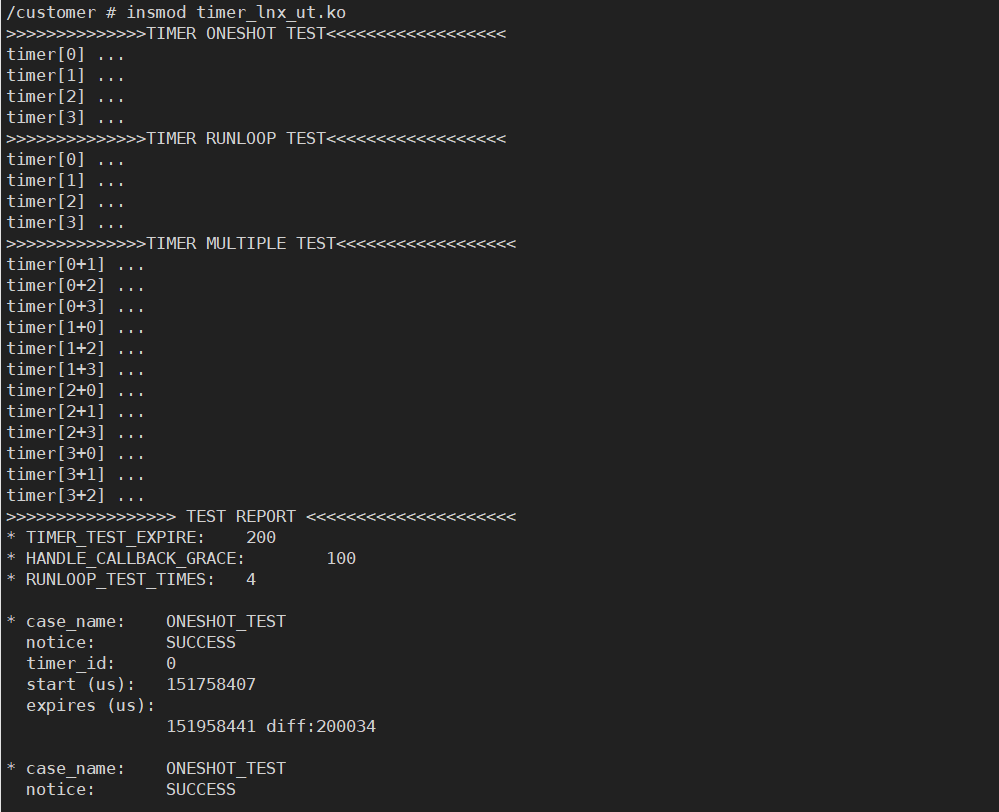
Linux testing demo:< Kernel>/drivers/drv_common/timer/ut/lnx/timer_lnx_ut.c, Compile and you can get timer_lnx_ut.ko, copy it to board then do insmod timer_lnx_ut.ko will begin test.
7. API reference
This functional module provides the following interfaces:
| API Name | Function |
|---|---|
| drv_timer_register | Registertimer |
| drv_timer_unregister | Unregister timer |
| drv_timer_start | Start timer |
| drv_timer_stop | Stop timer |
| drv_timer_get_current | Get the time that has passed since the timer was started until now |
| drv_timer_device_count | Get the number of timers |
| drv_timer_find_idle | Find the first avaiable timer |
The relevant header file is kernel/drivers/sgs_common/include/drv_timer.h.
7.1. drv_timer_register
-
Function
Register timer
-
Grammar
drv_timer_handle drv_timer_register(unsigned int timer_id, enum drv_timer_mode mode, drv_timer_callback callback, void *pdata); -
Parameters
Parameter Name Description timer_id timer ID [1,max] mode timer working model callback callback function, which will be called when Timer generates an interrupt *pdata Private data passed to callback function -
Return value
Return value Description handle pointer to a specific timer
7.2. drv_timer_unregister
-
Function
Unregister timer
-
Grammar
int drv_timer_unregister(drv_timer_handle handle) -
Parameters
Parameter Name Description handle pointer to a specific timer -
Return value
Return value Description 0 Successful
7.3. drv_timer_start
-
Function
Start timer
-
Grammar
int drv_timer_start(drv_timer_handle handle, unsigned long long exp_time) -
Parameters
Parameter Name Description handle pointer to a specific timer exp_time Timer expiration time (ms) -
Return value
Return value Description 0 Successful
7.4. drv_timer_stop
-
Function
Stop timer
-
Grammar
int drv_timer_stop(drv_timer_handle handle) -
Parameters
Parameter Name Description handle pointer to a specific timer exp_time Timer expiration time (ms) -
Return value
Return value Description 0 Successful
7.5. drv_timer_get_current
-
Function
Get the time that has passed since the timer was started until now.
-
Grammar
int drv_timer_get_current(drv_timer_handle handle, unsigned long long *ptime) -
Parameters
Parameter Name Description handle pointer to a specific timer ptime the time that has passed since the timer was started until now (ms) -
Return value
Return value Description 0 Successful
7.6. drv_timer_device_count
-
Function
Get the number of timers
-
Grammar
int drv_timer_device_count(void) -
Parameters
Parameter Name Description NA NA -
Return value
Return value Description 0 the number of timers
7.7. drv_timer_find_idle
-
Function
Find the first avaiable timer
-
Grammar
int drv_timer_find_idle(void) -
Parameters
Parameter Name Description NA NA -
Return value
Return value Description 0 The first available timer number
8. FAQ
NA